.png)
2026-08-31
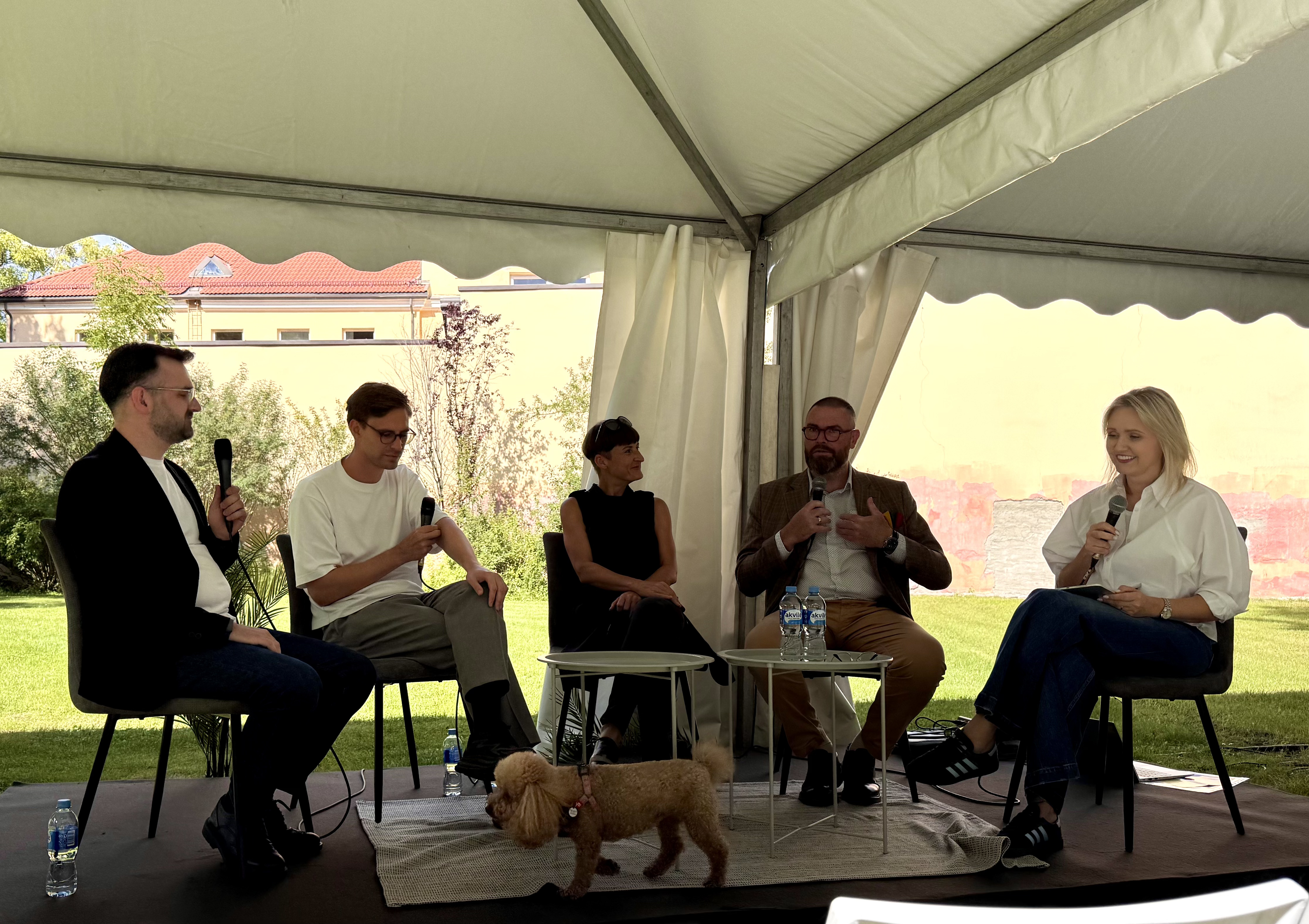
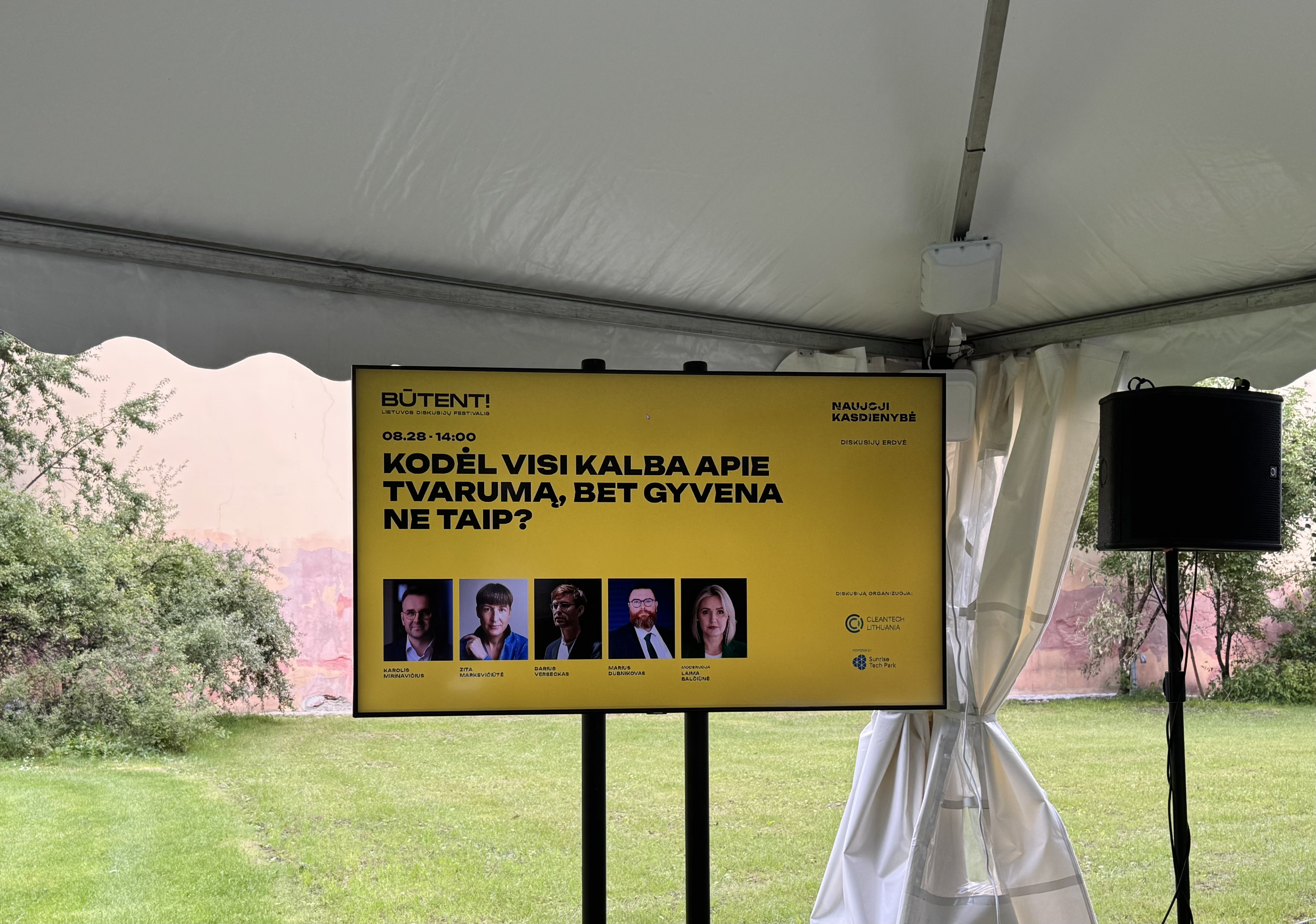
On August 28, at the BŪTENT! discussion festival, Cleantech Lithuania brought together representatives from business, energy, and finance to discuss one of the key paradoxes of sustainability: why do our stated intentions to live and consume more sustainably so often fail to align with our daily choices?
The discussion featured representatives from two Cleantech Lithuania members – Karolis Mirinavičius (Ignitis Group) and Zita Markevičiūtė (Pack'n GREEN) – as well as Darius Verseckas (Sigvi) and Marius Dubnikovas (Orion Securities). The conversation was moderated by Laima Balčiūnė, head of Saulėtekis Tech Park and founder of Cleantech Lithuania.
Who is responsible for change: the consumer, the business, or the state? Does a sustainable choice always mean consuming less? The nearly hour-long discussion showed that there are no simple answers. However, one idea was repeated with particular clarity: the sustainability argument alone is usually not enough.
Wanting to live more sustainably is one thing, but making choices based on that every day is quite another. Price, convenience, quality, and habits often carry more weight than an abstract desire to reduce one's environmental impact. Therefore, the discussion examined sustainability not as a moral choice between "good" and "bad," but as a highly practical issue. If a more sustainable product is more expensive, less convenient, or fails to meet the user's needs, the "green" argument alone may not be enough.
For businesses, this means a clear task: to create solutions where sustainability is more than just an extra label. They must compete on price, quality, convenience, technology, and real value for the individual. A sustainable choice must become one that a person makes not out of obligation, but because it is simply the better choice.
The conversation also touched on the paradox of the energy sector: on one hand, energy companies encourage consumers to save energy, while on the other, their business is naturally linked to growing consumption. Where does the true interest in sustainability lie here?
There was no single answer to this question, but Karolis Mirinavičius pointed out that higher electricity consumption does not automatically mean a greater environmental impact. As we electrify transport, heating, or industry, the demand for electricity may rise, but at the same time, the use of fossil fuels decreases and energy is used more efficiently. Therefore, it is important not only how much energy we consume, but also what kind of energy we consume and what it replaces.
The discussion inevitably shifted to the business side. Examples from the Lithuanian technology and cleantech ecosystem were discussed, including Vinted, InSoil, Fivrec, and Sigvi. They are united by an important idea: a sustainable innovation must solve a real problem. It must save resources, offer a more efficient process, a new business model, or some other tangible value.
This raised a more uncomfortable question about funding. Can a solution be called sustainable if it only exists as long as it receives subsidies or project funding? Economic viability, efficient use of capital, and the ability to survive in the market are also part of sustainability. This is especially relevant for the cleantech sector, where technologies must not only reduce environmental impact but also operate under real market conditions.
One of the most interesting directions of the discussion was sustainability reporting.
Measuring impact is necessary for companies. Without data, it is difficult to understand one's situation, set goals, or evaluate progress. However, a question also arose: when does measurement begin to overshadow the action itself? Complex reports and a multitude of indicators may be useful for a company internally, but they do not always help the end consumer make a clearer decision. A single emissions figure without context says very little.
Therefore, a question relevant to many organizations emerged in the discussion: how many resources do we allocate to actually reducing our impact, and how many to showing and justifying that we are reducing it? Accountability is necessary, but it must remain a means to an end, not an end in itself.
Who is ultimately responsible for ensuring that sustainable solutions become the norm? This responsibility cannot be left to the consumer alone. They choose from what is available on the market. Businesses create products and services, while the government shapes the rules, infrastructure, and economic incentives that can make certain choices easier than others.
Therefore, real change happens when these parts start working together. A consumer should not have to constantly choose between sustainability and price, sustainability and convenience, or sustainability and quality. A sustainable choice must become accessible, convenient, and economically rational.
This is precisely where the answer to the question posed in the title of this discussion lies. The gap between what we declare and how we live will not shrink when we tell people once again how they should behave, but rather when more sustainable solutions become a natural and attractive part of everyday life.